Getting there
The airfield is on the main motu, 4 km from the village of Rotoava. The fact sheet of the Circonscription des Tuamotu-Gambier gives a 1,200 m runway, a direct flight of 1 hr 05 min from Tahiti, six flights a week out from Papeete (none on Thursdays) and seven back, links with Rangiroa and Bora Bora and one with Tikehau on Wednesdays; it puts the atoll 431 km from Tahiti. Air Tahiti flies the route; Air Moana has served it since July 2025 according to the President’s report to the Assembly, from Tahiti, Bora Bora and Rangiroa. For most accommodation on the main motu, the transfer from the airfield is by truck. Tetamanu, the village at the southern pass, is reached by boat: over an hour, and about three hours from one pass to the other.
By sea, the Direction polynésienne des affaires maritimes lists the schooners Cobia 3, Dory, Mareva Nui and Saint-Xavier Maris Stella IV for the western Tuamotu; the sheet counts 9 to 12 passengers per schooner. The cargo-passenger ship Aranui 5 calls at the Rotoava quay on its way to the Marquesas: 250 nautical miles and 16 hr 40 min at sea from Papeete according to the DPAM atlas.
Climate and seasons
The Tuamotu climate is, for Météo-France, of the humid tropical type, with fairly distinct seasons. The rainy season runs from November to April, December and January being the wettest months; from May to October humidity drops. By its position the archipelago receives organised weather systems and humid air masses carried by the trade wind, but rainfall stays moderate, temperatures vary little and sunshine is good; with no relief, the wind blows undisturbed. Tahiti Tourisme quotes nearly 3,000 hours of sunshine a year for the archipelago. The Haut-commissariat points out that cyclone risk exists every year from November to April, and the Direction polynésienne des affaires maritimes relays Météo-France’s special bulletins from 1 November.
What makes the atoll
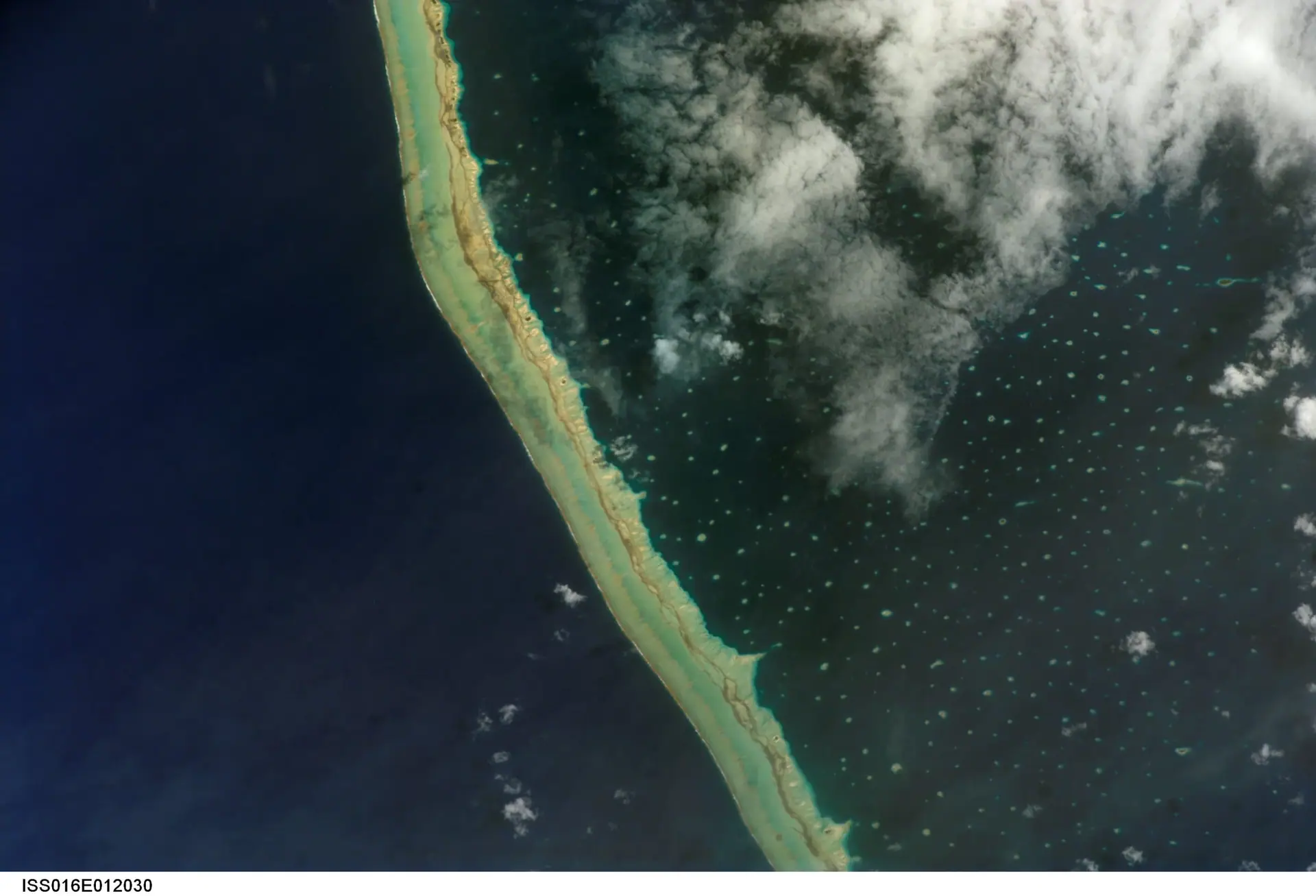
Garuae pass, in the north, 1,600 m wide, is the largest in French Polynesia: its currents call, according to Tahiti Tourisme, for drift-diving experience, at least level 2, but at slack water it opens to all levels. Grey sharks, manta rays, dolphins, turtles and barracudas are met there. In the south, Tumakohua pass, 200 m wide, near the old village of Tetamanu, is known for its “wall of sharks”: some 700 grey sharks are counted there, and the site is open to all levels; Tahiti Tourisme describes the current now as strong, now as gentler than Garuae’s.
The whole commune forms the UNESCO biosphere reserve: seven atolls, Fakarava, Aratika, Kauehi, Niau, Raraka, Taiaro and Toau. Order 949/CM of 18 July 2016 set the management plan for the maritime space, with its marine protected areas, and a reserve house, run by an association, stands in Rotoava. The beaches of the main motu and the other motu are of white or pink sand. Pearls are one of the atoll’s sources of income, with eight pearl farmers recorded in 2024, and a farm can be visited. The main motu can be toured by bicycle.
Where to stay and eat
Tahiti Tourisme counts more than twenty places to stay on the atoll. The fact sheet of the Circonscription des Tuamotu-Gambier details, on 30 June 2024, 15 family guesthouses, 12 of them in Rotoava and 3 in Tetamanu, 11 holiday rentals, 2 bed-and-breakfasts and one campsite, and mentions no hotel. The list of guesthouses in business on 31 March 2026 confirms the spread: nearly all in Rotoava or along the main motu, two in Tetamanu near the southern pass, and one on a motu. The guesthouses serve breakfast and dinner, mostly fresh fish and the atoll’s produce; some lend bicycles. Beyond that, Rotoava has 5 shops, 11 snack bars, 3 food trucks, a bakery, a snack-bar and a pizzeria according to the 2024 sheet. Anyone staying in Tetamanu depends on the guesthouse boat for every trip.
On the atoll
Tourist tax: the commune of Fakarava has no website, and no deliberation could be consulted; the Haut-commissariat’s table of the 2009 accounts shows it was collecting the tax. Until 31 December 2026 the 1997 regime applies, 20 to 60 F CFP per person per night outside classified hotels, children under 12 exempt; from 1 January 2027, country law 2025-38 sets a ceiling of 100 F CFP in family guesthouses and exempts children under 2. Money: one cash machine in Rotoava; bring cash, the dollar is not accepted. Health: a medical centre in Rotoava, with a visiting doctor, two nurses and two health auxiliaries. Water: the atoll lives on treated rainwater; a prepaid drinking-water point stands at the quay, 5 F CFP a litre, and mains water is not drunk untreated, the Centre de santé environnementale advising a minute’s boiling. Electricity runs around the clock; the Natitua cable brings fibre and the OPT has an office at the quay. Fakarava was among the islands hardest hit by dengue in 2024–2025; repellents and long clothing remain the rule.
Sources: UNESCO, réserve de biosphère de la commune de Fakarava · Tahiti Tourisme, Fakarava · Tahiti Tourisme, venir à Fakarava · ISPF, populations légales 2022 · Circonscription des îles Tuamotu et Gambier, Fiche atoll Fakarava (MAJ 31/07/2024) · Tahiti Tourisme, The best diving spots in Fakarava · Tahiti Tourisme, Escape to Fakarava · Air Moana, Vols directs inter-îles · Présidence de la Polynésie française, Rapport à l’Assemblée, année 2025, section Air Moana – Natireva · DPAM, Départs des navires de Tahiti vers les archipels · DPAM, Atlas des lignes maritimes, section Marquises (Aranui 5, statistiques 2021) · Aranui, Les îles des Tuamotu · Météo-France Polynésie française, Climat · Tahiti Tourisme, Frequently asked questions · Haut-commissariat de la République en Polynésie française, Saison cyclonique · DPAM, Saison cyclonique 2019-2020 à surveiller · Service du tourisme, Liste des pensions de famille en activité au 31 mars 2026, Tuamotu-Gambier · Haut-commissariat, note Taxe de séjour (séminaire fiscalité communale, 2011) · Assemblée de la Polynésie française, rapport sur le projet de loi du pays portant diverses mesures fiscales (novembre 2025) · DICP, Réforme de la taxe de séjour (13 mai 2026) · Tahiti Tourisme, Exchange and currency · Centre de santé environnementale, Les eaux de consommation · Bureau de veille sanitaire, Bulletin de surveillance sanitaire n° 45 (S48 2025) · checked 19 October 2026