Getting there
Most visitors come by air: the direct flight from Tahiti-Faa’a takes about 40 minutes, with a view of Moorea on the way, and the links from Bora Bora, Raiatea or Moorea take 20 to 35 minutes. Air Tahiti serves the island from Papeete and Bora Bora; Air Moana sells flights to Huahine from Tahiti and Moorea, opened in July 2025; a charter flight is also possible. By sea, the Apetahi Express makes Huahine its first call out of Papeete, about three hours after Tahiti, before Raiatea, Taha’a and Bora Bora; its ticket office on the island is at the Maison du Tourisme in Fare, and photo ID is required for its tickets. The Vaeara’i also serves Huahine; Tahiti Tourisme counts between three and a half and four hours by ferry.
Once there, hiring a car, scooter or bike is essential, as taxis are rare; several hire companies operate on the island, and e-bikes are available too. The coast road is about 30 km long and a tour of the island takes half a day; a bridge joins Huahine Nui to Huahine Iti.
Climate and seasons
Huahine shares the humid tropical climate of the Society Islands: a rainy season from November to April, December and January the wettest months, a cool dry season from June to September, April–May and October–November in transition, March the warmest month; the coasts exposed to the trade wind and the heights receive more rain than the sheltered coasts. The archipelago’s annual mean, measured at Faa’a, is 26 °C, and cyclone risk affects the whole of French Polynesia from November to April. Tahiti Tourisme places the dry season from May to October, with lower humidity and light breezes, and the water temperature between 27 and 29 °C.
The territorial sea around Huahine is one of the areas where the Direction de l’environnement authorises humpback whale watching, the whales being present from July to the end of October; licensed outings take place only from 20 July to 20 November, with a single licensed boat per island and per company group, and never in the lagoon, the bays or the passes.
What makes the island
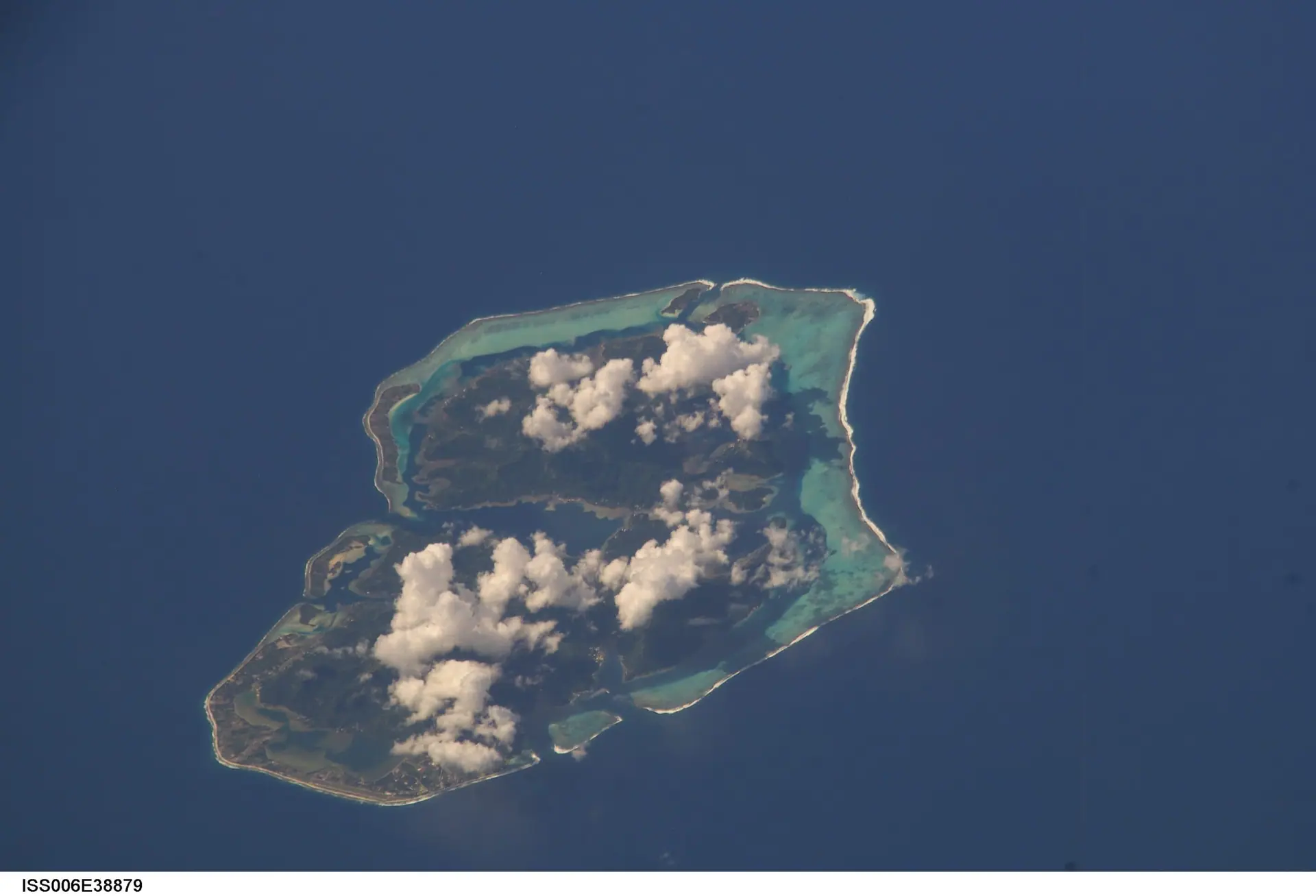
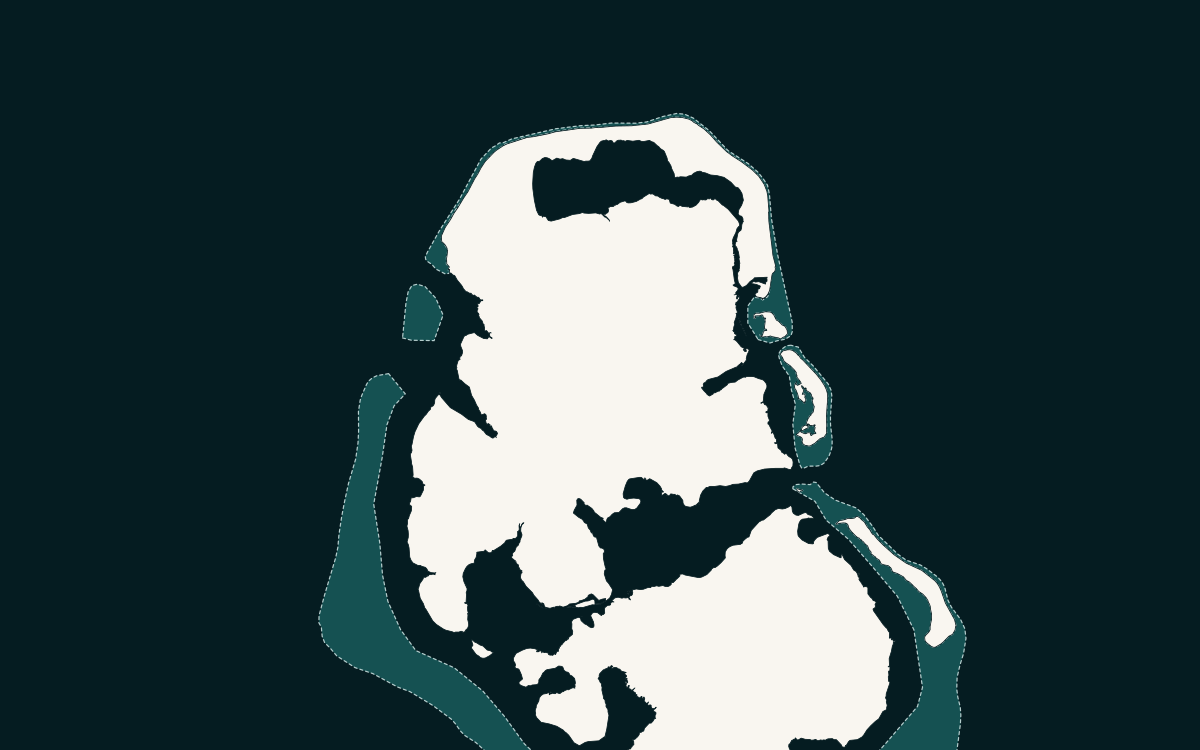
Huahine is made of two islands, Huahine Nui and Huahine Iti, joined by a bridge within one lagoon; Tahiti Tourisme calls it “the secret island”, its former name was Matairea, and the main village is Fare. The lagoon holds coral gardens, manta rays and reef sharks, and the lagoons of both bays are suited to swimming. Hana Iti beach, on the south coast, is held to be one of the most beautiful in Polynesia, and Bourayne beach, on the east coast, offers an open view. Near the village of Faie, a stream is home to the sacred blue-eyed eels. The island’s only pearl farm offers an educational visit, paired with a pottery workshop.
The tour of the island, sleepy villages, beaches and archaeological sites, takes half a day by the coast road. The trails of Maeva are among the hikes that Tahiti Tourisme recommends doing with a guide, as everywhere in the islands, because of the weather, private land and knowledge of the paths.
Marae and villages
Huahine has a rich archaeological heritage, with a multitude of marae, some very imposing, and remains scattered across the whole island. The recommended starting point is the Fare Pote’e at Maeva, a traditional house turned museum, on a sacred site once used for ceremonies; the village of Maeva had eight chiefdoms, hence the density of remains, and the nearby marae Manunu has an impressive ahu, a stone platform. Not far away, the stone fish traps, built in a V to catch fish in ancient times, are still used by today’s fishermen. Tahiti Tourisme also notes that the American singer Bobby Holcomb lived on Huahine for twenty-five years, until his death in 1991.
The Huahine tourism committee, at the Fare Manihini in Fare, gives information on visits, and the Maison du Tourisme in Fare sells the Apetahi Express tickets.
Where to stay and eat
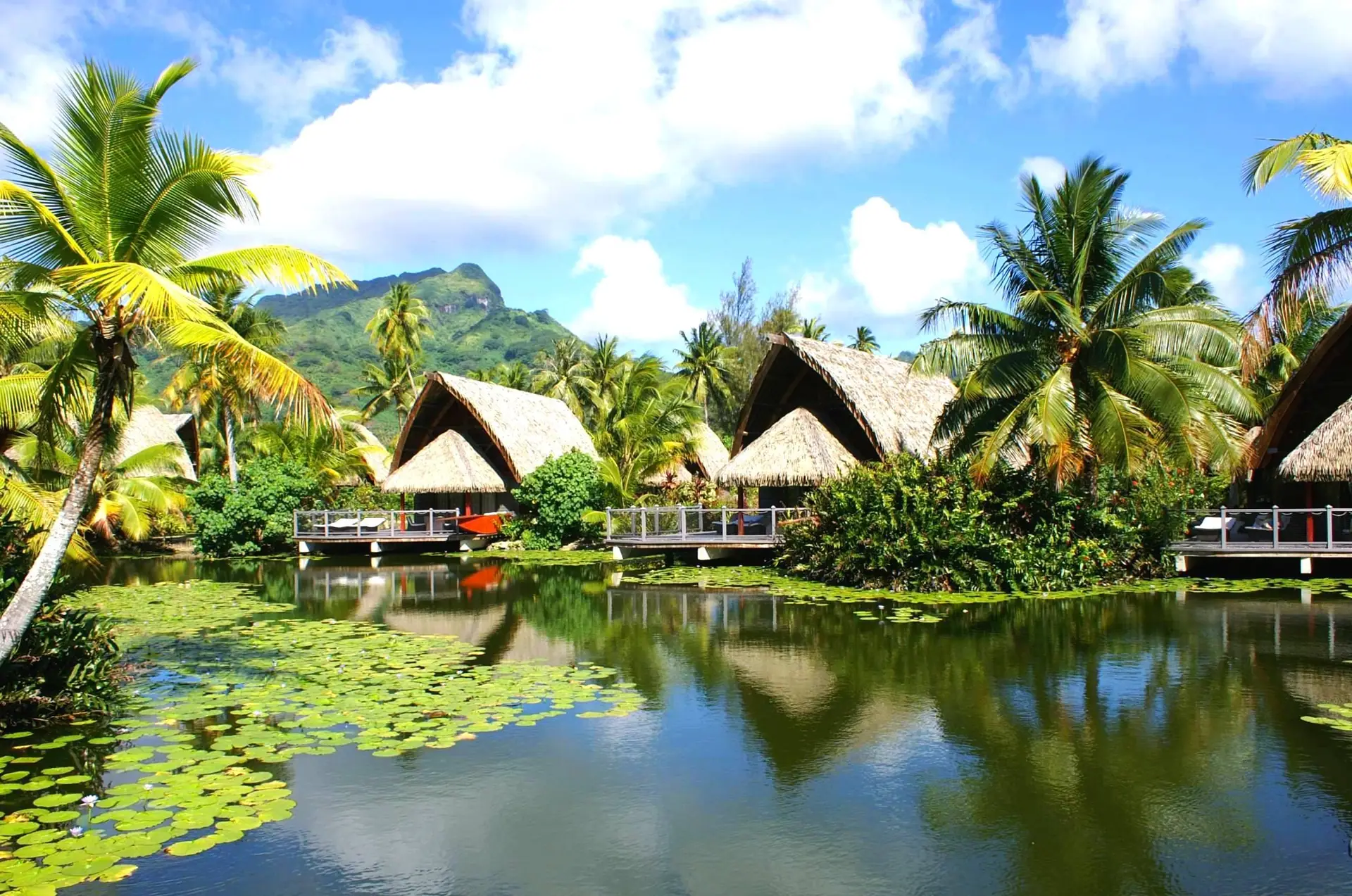
Tahiti Tourisme lists two hotels on the island, with beach access and water activities for their guests, family guesthouses, many furnished rentals of varied types and prices, and three campsites for those seeking simplicity. The guesthouses, small family businesses, are described as clean and comfortable, close to the local population; most have dining facilities, and their hosts sometimes prepare the meals themselves with local ingredients. They remain the most affordable option, the two hotels and the rentals covering a wider range of prices depending on comfort and location.
Charter sailboats and cruise companies also include Huahine in their itineraries, for those who prefer to sleep on board.
On the island
The commune of Huahine introduced its tourist tax in 2000, but the rate in force until 31 December 2026 is not published online: ask your host; the territorial framework runs from 80 to 200 F per person per night in a classified hotel and from 20 to 60 F elsewhere, children under 12 exempt. For stays from 1 January 2027, deliberation no. 50/2026 of 5 June 2026 sets the amounts per person per night: 1,500 F in a five-star hotel or luxury villa, 1,000 F in four-star, 900 F in three-star, 800 F in a furnished rental, 600 F in two-star, unclassified hotels or cruise ships, 100 F in a family guesthouse, bed and breakfast, hostel or campsite; only children under two, people in emergency housing, seasonal workers employed in the commune and staff on assignment are exempt.
The currency is the Pacific franc (1,000 XPF = 8.38 EUR); Tahiti Tourisme warns that cash is often needed on islands other than Tahiti and Bora Bora. Tap water is not guaranteed drinkable in every commune: check on tefenua.gov.pf or boil it for at least a minute.
Sources: Tahiti Tourisme, Huahine · Tahiti Tourisme, Apetahi Express · Tahiti Tourisme, venir à Huahine · ISPF, populations légales 2022 · Tahiti Tourisme, venir et se déplacer à Huahine · Air Moana, destinations · Présidence de la Polynésie française, rapport annuel 2025, Air Moana – Natireva · Apetahi Express et Tauati Ferry, agences et points de vente · Météo-France Polynésie française, climat · Météo-France, note TRACC archipel de la Société (2026) · Haut-commissariat, saison cyclonique · Tahiti Tourisme, météo et saisons · Direction de l’environnement, mammifères marins 2025 · Tahiti Tourisme, immersion culturelle à Huahine · Tahiti Tourisme, ferme perlière de Huahine · Tahiti Tourisme, guide de la randonnée · Tahiti Tourisme, hébergements à Huahine · Commune de Huahine, délibération n. 50/2026, taxe de séjour · Haut-commissariat, note sur la taxe de séjour (2011) · Assemblée de la Polynésie française, rapport sur le projet de loi du pays portant diverses mesures fiscales (novembre 2025) · IEOM, taux de change · Tahiti Tourisme, monnaie et change · Centre de santé environnementale, les eaux de consommation · Tahiti Tourisme, Comité du tourisme de Huahine · checked 19 October 2026