Getting there
Raiatea airport lies 2.4 km north-west of Uturoa, the main town, where taxis and car-hire desks are found; Air Tahiti and Air Moana appear on its flight boards. Tahiti Tourisme counts several flights a day from Tahiti, of about 45 minutes, and recommends booking ahead, as the route is busy; Bora Bora is 20 minutes away by air, and Air Moana states 50 minutes to Tahiti. By sea, three vessels include Raiatea among their destinations: the Apetahi Express, which makes it its second call out of Papeete after Huahine before going on to Taha’a and Bora Bora, the Vaeara’i and the Maupiti Express 2; Tahiti Tourisme counts 5 to 8 hours by boat depending on the operator. The Ratere agency, at the Uturoa ferry terminal, sells the Apetahi Express tickets, and the tourist office at the terminal opens on Saturday and Sunday at the boat’s arrival times.
The round-island road is more than 50 miles, over 80 km: cars for hire at the airport or in Uturoa, scooters, bikes and e-bikes, many taxis in town and a reasonably reliable bus service with trucks. Taxi-boats and shuttles move about the lagoon, and ferries leave for Taha’a several times a day.
Climate and seasons
Raiatea has the humid tropical climate of the Society Islands: a rainy season from November to April, December and January the wettest, a cool dry season from June to September, April–May and October–November in transition, March the warmest month; the coasts exposed to the trade wind and above all the heights, which Raiatea has, receive far more rain. The archipelago’s annual mean, measured at Faa’a, is 26 °C; cyclone risk affects the whole of French Polynesia from November to April, and Tahiti Tourisme gives a water temperature of 27 to 29 °C.
The territorial sea around Raiatea is one of the areas where the Direction de l’environnement authorises humpback whale watching, the whales being present from July to the end of October; licensed outings take place only from 20 July to 20 November, from 7.30 am to 5.30 pm, and never in the lagoon, the bays or the passes.
What makes the island
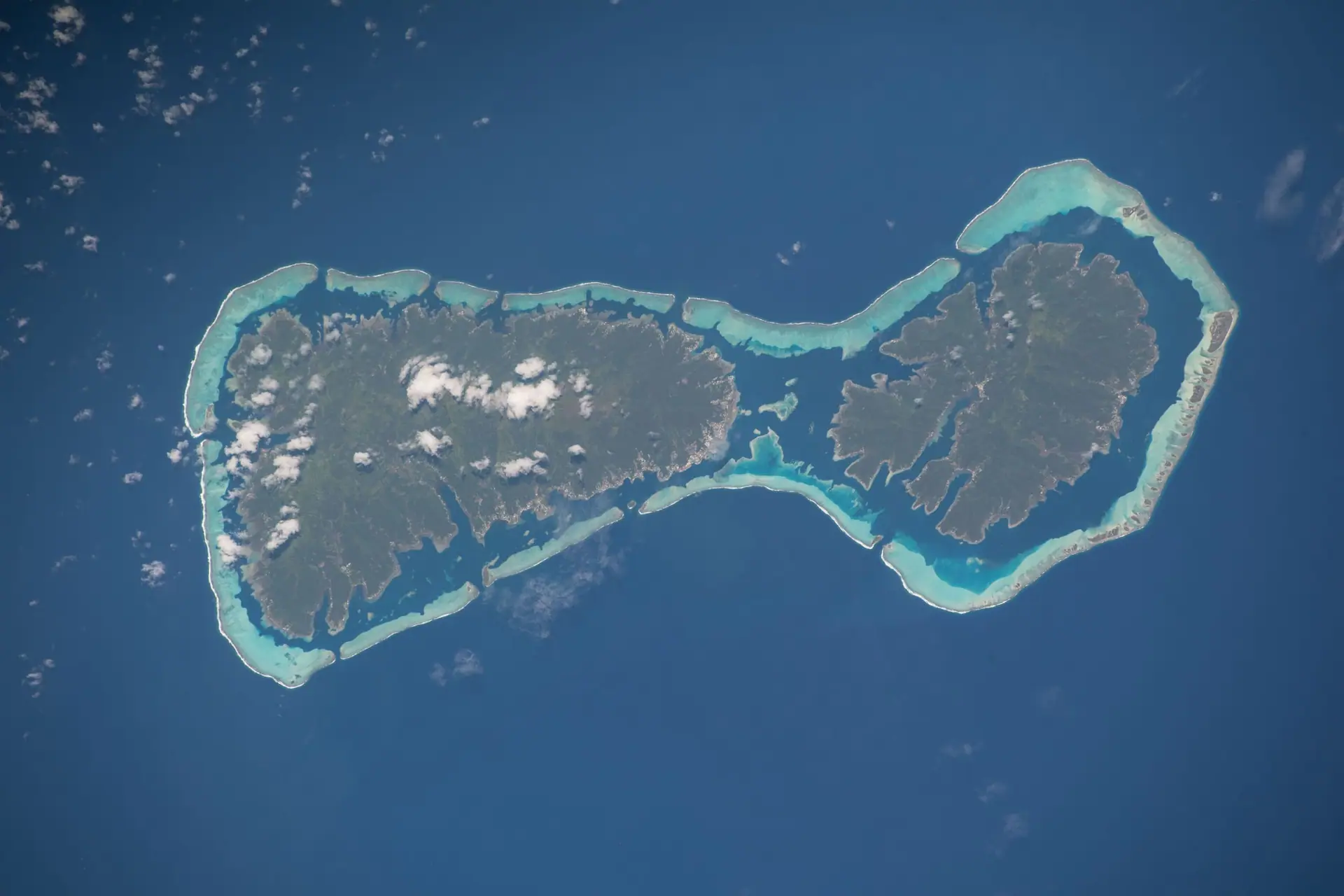
Raiatea shares its lagoon with Taha’a, and this turquoise lagoon holds a multitude of motu with white-sand beaches, where the day is spent picnicking with your feet in the water. The Faaroa river, described as Polynesia’s only navigable river, is explored on excursions. Mount Temehani (1,017 m) is the last refuge in the world of the tiare apetahi, the island’s emblematic flower; the climb is rated hard, takes six hours, and a guide is required; from the top you see Taha’a and Bora Bora. For diving, the Te Ava Piti pass, sheltered by a plateau at 10 m, is one of the most sought-after drift dives in the Society Islands, with blacktip and whitetip sharks, barracuda, jacks and leopard rays; the wreck of the Nordby, a Danish three-master that sank in the lagoon in 1900 on her way from Auckland to Liverpool, lies at 30 m and is dived by day and by night.
Raiatea is also the base of the charter yachts: fleets of catamarans sail from the Apooiti marina, in Uturoa, with or without crew; one charter company at the marina requires at least two years’ experience as skipper to charter without one.
Taputapuātea
The marae of Taputapuātea, at PK 32 in Opoa, facing the sacred pass of Ava Mo’a, has been on the UNESCO World Heritage List since 2017, under criteria (iii), (iv) and (vi): “an exceptional testimony to 1,000 years of mā’ohi civilization”, a cultural landscape and seascape whose complex is dedicated to the god ’Oro, protected under French Polynesian law since 1952 and covered by a management plan since 2015; the property covers 2,124 ha, its buffer zone 3,363 ha. Tahiti Tourisme presents Raiatea as the birthplace of Polynesian culture, the marae having been the centre of religious and political power in all of Polynesia.
On site the rules are simple: stay on the paths, do not climb on the stones, no picnics, no animals. The island’s restaurants are concentrated around Uturoa and in Taputapuatea, which makes it easy to combine the visit with lunch.
Where to stay and eat
Tahiti Tourisme describes a wide choice: a modern hotel in the centre of Uturoa, family guesthouses run by Polynesian families, lodges and bungalows on the lagoon shore, some on a private beach, villas with a fitted kitchen, a hotel on a private islet and furnished rentals. The small family-run hotels and the guesthouses remain the most affordable options; the lagoon-front hotels and lodges, with pool and terraces, charge higher rates depending on comfort. Added to these are stays aboard the sailboats that leave from Uturoa.
The restaurants are concentrated around Uturoa and in Taputapuatea, from small eateries to fine dining; some, at the water’s edge, overlook the lagoon, others serve outdoors, under the stars. A roulotte at the entrance to Uturoa remains the cheapest option. Traditional cooking rests on fish from the lagoon and the open sea, and raw fish in coconut milk (ia ota) is the dish to try.
On the island
Raiatea has three communes, Uturoa, Taputapuatea and Tumaraa; none has published the rate of its tourist tax online, so it could not be checked against an official source: ask your host. Until 31 December 2026 the territorial framework runs from 80 to 200 F per person per night in a classified hotel and from 20 to 60 F elsewhere, children under 12 exempt; from 1 January 2027, country law no. 2025-38 sets ceilings from 1,500 F in a five-star hotel to 100 F in a family guesthouse, only children under two remaining exempt, the tax being settled with the host before departure.
The currency is the Pacific franc (1,000 XPF = 8.38 EUR); outside Tahiti and Bora Bora, Tahiti Tourisme warns that cash is often needed. Tap water is not guaranteed drinkable in every commune: check on tefenua.gov.pf or boil it for at least a minute. The tourist office at the Uturoa ferry terminal (+689 40 60 07 77) opens Monday, Wednesday, Thursday and Friday from 8 am to 4 pm, and at weekends for the Apetahi Express arrivals; it also gives information on Taha’a and can make bookings there.
Sources: UNESCO, Taputapuātea · Tahiti Tourisme, Raiatea · Tahiti Tourisme, mont Temehani · Aéroport de Tahiti, Raiatea · ISPF, populations légales 2022 · Tahiti Tourisme, venir et se déplacer à Raiatea · Tahiti Tourisme, venir à Raiatea · Air Moana, destination Tahiti · Tahiti Tourisme, Apetahi Express · Apetahi Express et Tauati Ferry, agences et points de vente · Tahiti Tourisme, Office du tourisme de la gare maritime d’Uturoa · Météo-France Polynésie française, climat · Météo-France, note TRACC archipel de la Société (2026) · Haut-commissariat, saison cyclonique · Tahiti Tourisme, météo et saisons · Direction de l’environnement, mammifères marins 2025 · Tahiti Tourisme, randonnée du mont Temehani · Tahiti Tourisme, plongée à Raiatea · Tahiti Yacht Charter, base de Raiatea · Tahiti Tourisme, Tahiti Yacht Charter, marina Apooiti · Tahiti Tourisme, explorer Taputapuātea · Tahiti Tourisme, hébergements à Raiatea · Tahiti Tourisme, où manger à Raiatea · Commune de Tumaraa, délibérations 2026 · Service-public.pf, annuaire des communes · Haut-commissariat, note sur la taxe de séjour (2011) · Assemblée de la Polynésie française, rapport sur le projet de loi du pays portant diverses mesures fiscales (novembre 2025) · IEOM, taux de change · Tahiti Tourisme, monnaie et change · Centre de santé environnementale, les eaux de consommation · Tahiti Tourisme, venir et se déplacer à Taha’a · checked 19 October 2026