Getting there
Tahiti-Faa’a international airport is the only international air gateway to French Polynesia; the company Aéroport de Tahiti (ADT) has held its concession since 2010. Air France, Air Tahiti Nui, French Bee, Air New Zealand, Hawaiian Airlines, United and Aircalin are among the airlines that serve it; Air Tahiti and Air Moana fly on to the other islands. On the way out, a taxi rank stands in front of Terminal 1; taxi fares for Tahiti and Moorea are set by the Council of Ministers and posted inside the vehicles. Five car-hire companies share an area to the right of the international check-in desks, open daily from 5 am to 8 pm and later for international arrivals. The buses of the Tere Tahiti network stop on the ring road, in both directions.
For the other islands by sea, everything leaves from Papeete: the ferry terminal is the departure point of the shuttles to Moorea (Aremiti, Terevau, Tauati Ferry and Vaeara’i) and of the Apetahi Express to Huahine, Raiatea, Taha’a and Bora Bora; the cargo-passenger ships Aranui 5, to the Marquesas, and Tuhaa Pae IV, to the Austral Islands, also sail from Tahiti.
Climate and seasons
Météo-France classes the climate of the Society Islands as humid tropical, with a clearly marked annual cycle: the rainy season begins in November and ends in April, December and January being the wettest months, and the rain often becomes light in the cool season. At Faa’a the annual mean temperature is 26 °C, warm but not excessive; the coasts exposed to the trade wind and above all the heights receive far more rain. Météo-France’s climate note for the archipelago places the cool dry season from June to September, with April–May and October–November as transition periods and March as the warmest month. The Haut-commissariat reminds visitors that from November to April French Polynesia is exposed to cyclone risk.
Humpback whales arrive from July to the end of October according to the Direction de l’environnement; observation permits are valid only from 20 July to 20 November, and Tahiti is one of the islands where licensed outings are run, at Punaauia in particular. For surfers, the Teahupo’o wave works mainly from April to October, and a competition is held there every year in August.
What makes the island
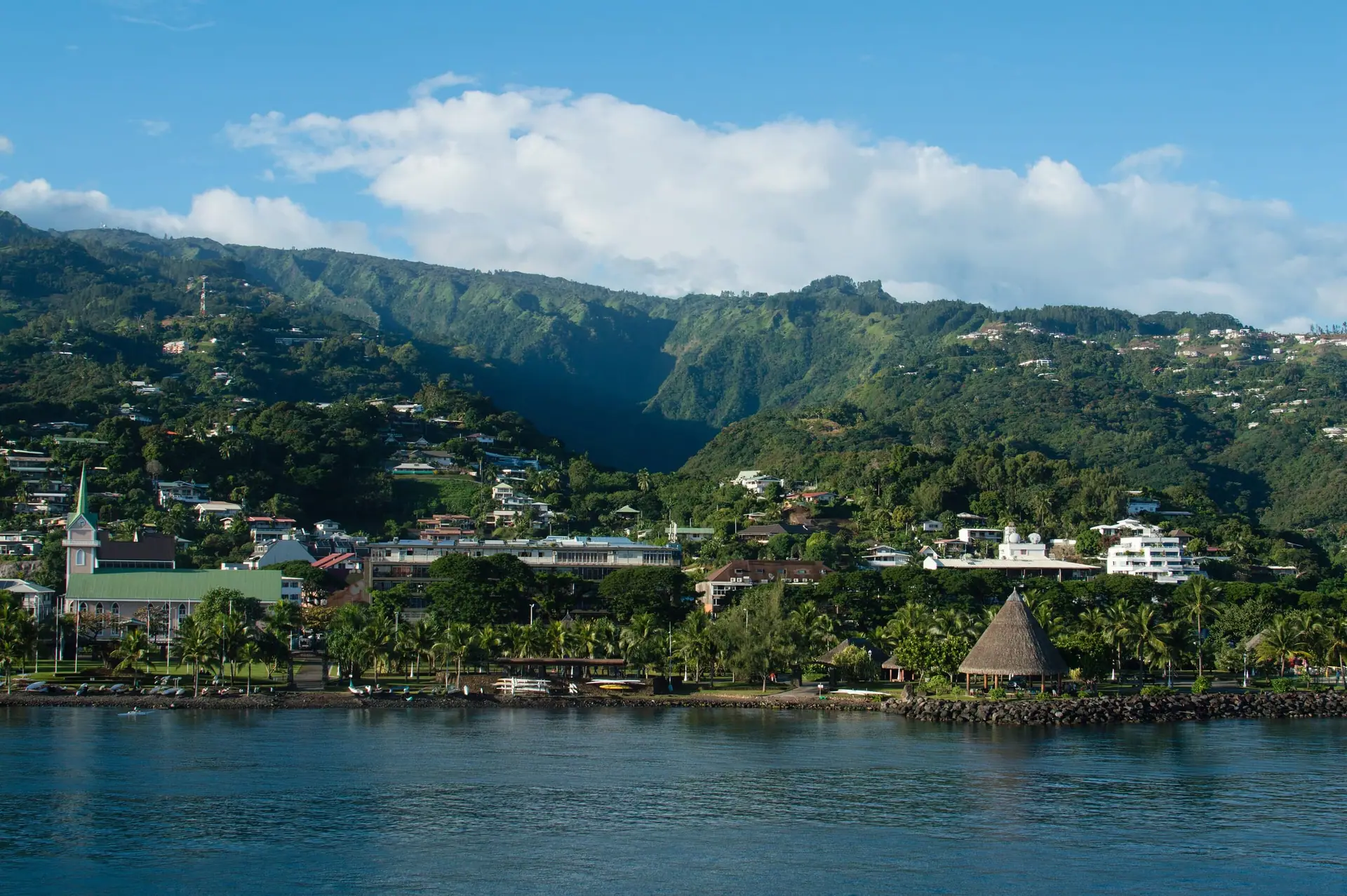
Papeete first: the municipal market, on two floors, opens every day from early morning, the ground-floor stalls Monday to Sunday and the upper floor Monday to Saturday; Sunday before 7 am is the liveliest moment. Behind the town, the Fautaua valley is visited with a permit from the Papeete town hall (600 F per adult, 150 F per child from the age of 12), the valley being open from 6 am to 5 pm; the first three kilometres to the Fachoda bridge are easy and shaded. At Punaauia, at PK 15, the Musée de Tahiti et des Îles opens Wednesday to Sunday from 9 am to 5 pm, admission 1,000 XPF, free under 18. At Paea, at PK 22.5 on the mountain side, the marae Arahurahu, restored in 1953, hosts a re-enactment every July during the Heiva, itself staged on the To’atā square, from 2 to 18 July in 2026.
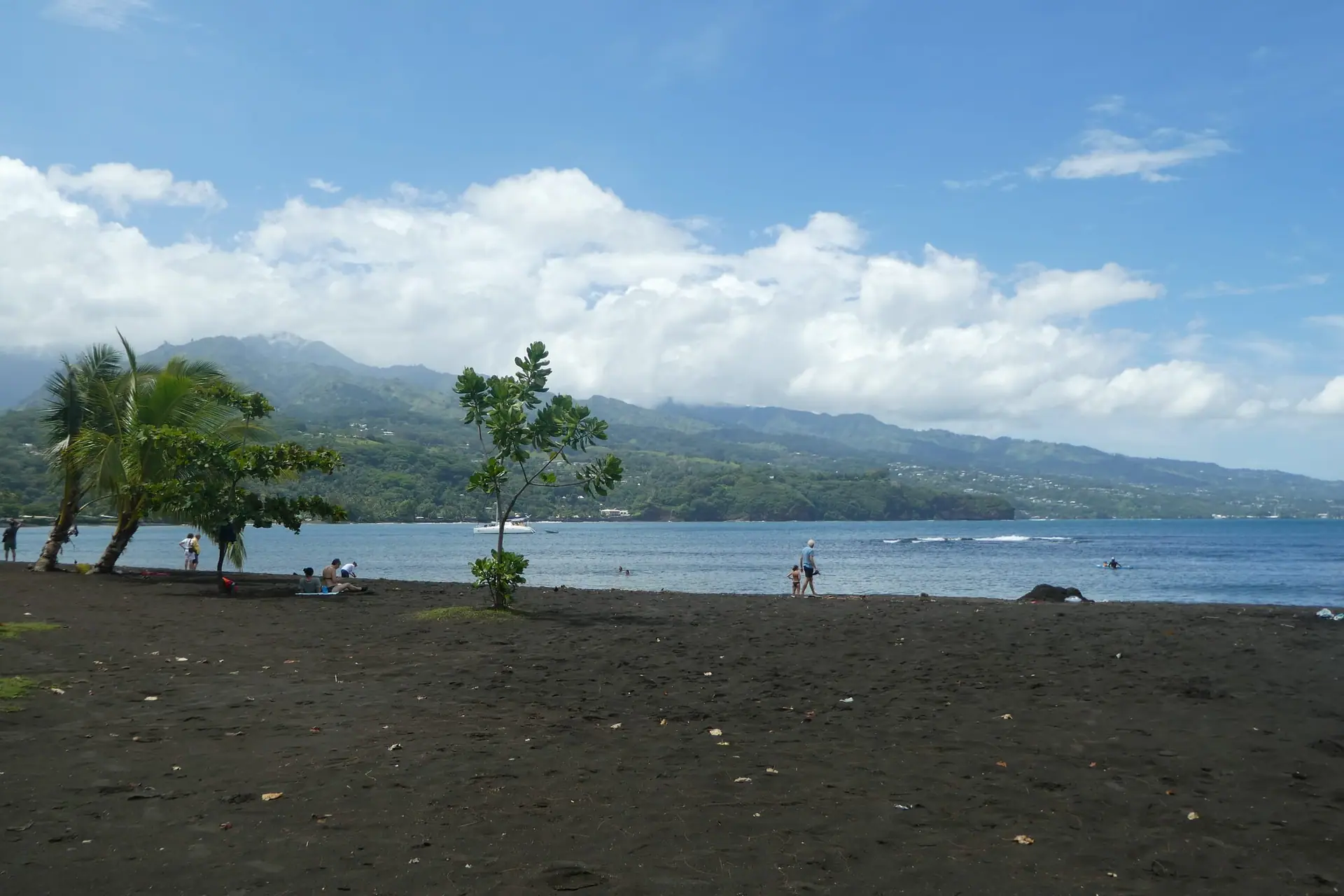
Further out, the east coast has a string of black-sand beaches, the Papenoo valley fills a day, and at the end of the peninsula road, at PK 0, the left-hander of Teahupo’o, venue of the Paris 2024 surfing events, is for experts only; beginners learn at Papenoo or Papara.
Where to stay and eat
Tahiti Tourisme lists classified hotels of up to four stars, family guesthouses, furnished holiday rentals and campsites; guesthouses and rentals remain the most affordable options, while the hotels cover a wider range of prices depending on comfort and location. The accommodation is spread between Papeete, Punaauia, Faa’a, Paea and the peninsula, from Afaahiti to Teahupo’o; the Tahiti Iti peninsula and its coves suit those who want to get away from the town.
For meals, the Papeete waterfront and its surroundings hold the island’s highest concentration of restaurants and roulottes; Punaauia is the second hub, and there are good places to eat in Pirae, Arue, Faa’a and on the peninsula as far as Teahupo’o. The roulottes remain the cheapest option: every evening from 6.30 pm, Place Vaiete turns into a night market serving Polynesian, Chinese, French and international food; it is best to arrive early, as Polynesians eat early. Raw fish in coconut milk, chao men and grilled rib steak are the evening dishes.
Tourist tax
The tourist tax is municipal and is paid to the host. Until 31 December 2026 the old regime applies: in Punaauia, 200 F per person per night in international tourist hotels and 60 F in family guesthouses, furnished rentals, hostels and campsites; in Arue, 150 F in classified hotels and 50 F in unclassified establishments; children under 12 are exempt. The rate of the commune of Papeete could not be checked against an official source: ask your host.
From 1 January 2027, country law no. 2025-38 replaces this regime. Punaauia and Arue have already voted their rates: 1,500 F per person per night in five-star hotels and luxury villas, 1,000 F in four-star, 900 F in three-star, 600 F in two-star or unclassified hotels, 100 F in family guesthouses, bed and breakfasts, hostels or campsites; furnished rentals pay 800 F in Punaauia and 300 F in Arue. Only children under two remain exempt, and the tax is settled before departure. On the same date the tourism promotion levy disappears and VAT on tourist accommodation moves to 9%, except family guesthouses and bed and breakfasts, which stay at the reduced rate.
On the island
The currency is the Pacific franc (XPF), pegged to the euro: 1,000 XPF = 8.38 EUR. Shops are required to accept CFP franc notes and coins; Tahiti Tourisme states that Visa and Mastercard are accepted in most hotels and shops in Tahiti, but that US dollar notes and coins are not. Tap water is not drinkable everywhere: the Centre de santé environnementale explains that only some communes have a supply that meets the standards, to be checked commune by commune on tefenua.gov.pf; when in doubt, boil the water for at least a minute, and never drink untreated rainwater. Dengue circulates at a low level in the inter-epidemic period (bulletin of June 2026): repellent, long clothing and removal of standing water.
The tourist office on the Papeete waterfront (+689 40 50 40 30) opens Monday to Friday from 8 am to 5.30 pm and Saturday from 8 am to 4 pm; a second information point is at Faa’a airport. The Tere Tahiti buses link Papeete with every district of the island, the destination shown on the front of the bus; the network has 21 regular lines, and the operator’s app shows the buses’ position in real time.
Sources: Tahiti Tourisme, Tahiti · Aéroport de Tahiti, présentation · Haut-commissariat, aviation civile · Tahiti Tourisme, mont Orohena · Météo-France Polynésie française, climat · ISPF, populations légales 2022 · Aéroport de Tahiti, accueil · Aéroport de Tahiti, transports et taxis · Aéroport de Tahiti, location de voitures · Direction des transports terrestres, tarifs des taxis de Tahiti et Moorea · Direction des transports terrestres, transports en commun · DPAM, navettes Moorea · DPAM, départs des navires de Tahiti vers les archipels · Tahiti Tourisme, Apetahi Express · Aranui, accueil · Tahiti Tourisme, d’île en île · Météo-France, note TRACC archipel de la Société (2026) · Haut-commissariat, saison cyclonique · Direction de l’environnement, mammifères marins 2025 · Tahiti Tourisme, baleines · Comité international olympique, Teahupo’o, site de surf de Paris 2024 · Tahiti Tourisme, pointe de Teahupo’o · Tahiti Tourisme, que faire à Tahiti · Commune de Papeete, cahier des charges du marché municipal 2025 · Commune de Papeete, autorisation d’accès à la vallée de la Fautaua · Tahiti Tourisme, vallée de la Fautaua · Musée de Tahiti et des Îles, tarifs et horaires · Tahiti Tourisme, Musée de Tahiti et des Îles · Tahiti Tourisme, marae Arahurahu · Te Fare Tauhiti Nui – Maison de la Culture, Heiva i Tahiti 2026 · Tahiti Tourisme, hébergements à Tahiti · Tahiti Tourisme, où manger à Tahiti · Ville de Punaauia, payer sa taxe de séjour · Ville de Punaauia, taxe de séjour au 1er janvier 2027 · Commune de Arue, délibération 2025/80, tarifs communaux · Commune de Arue, délibération 2026/79, taxe de séjour 2027 · DICP, réforme de la taxe de séjour · Assemblée de la Polynésie française, rapport sur le projet de loi du pays portant diverses mesures fiscales (novembre 2025) · IEOM, taux de change · IEOM, pièces et billets en circulation · Tahiti Tourisme, monnaie et change · Centre de santé environnementale, les eaux de consommation · Direction de la santé, bulletin de surveillance sanitaire n° 21 (juin 2026) · Tahiti Tourisme, Office du tourisme du front de mer de Papeete · Tahiti Tourisme, points d’information touristique · Tahiti Tourisme, venir à Tahiti · checked 19 October 2026